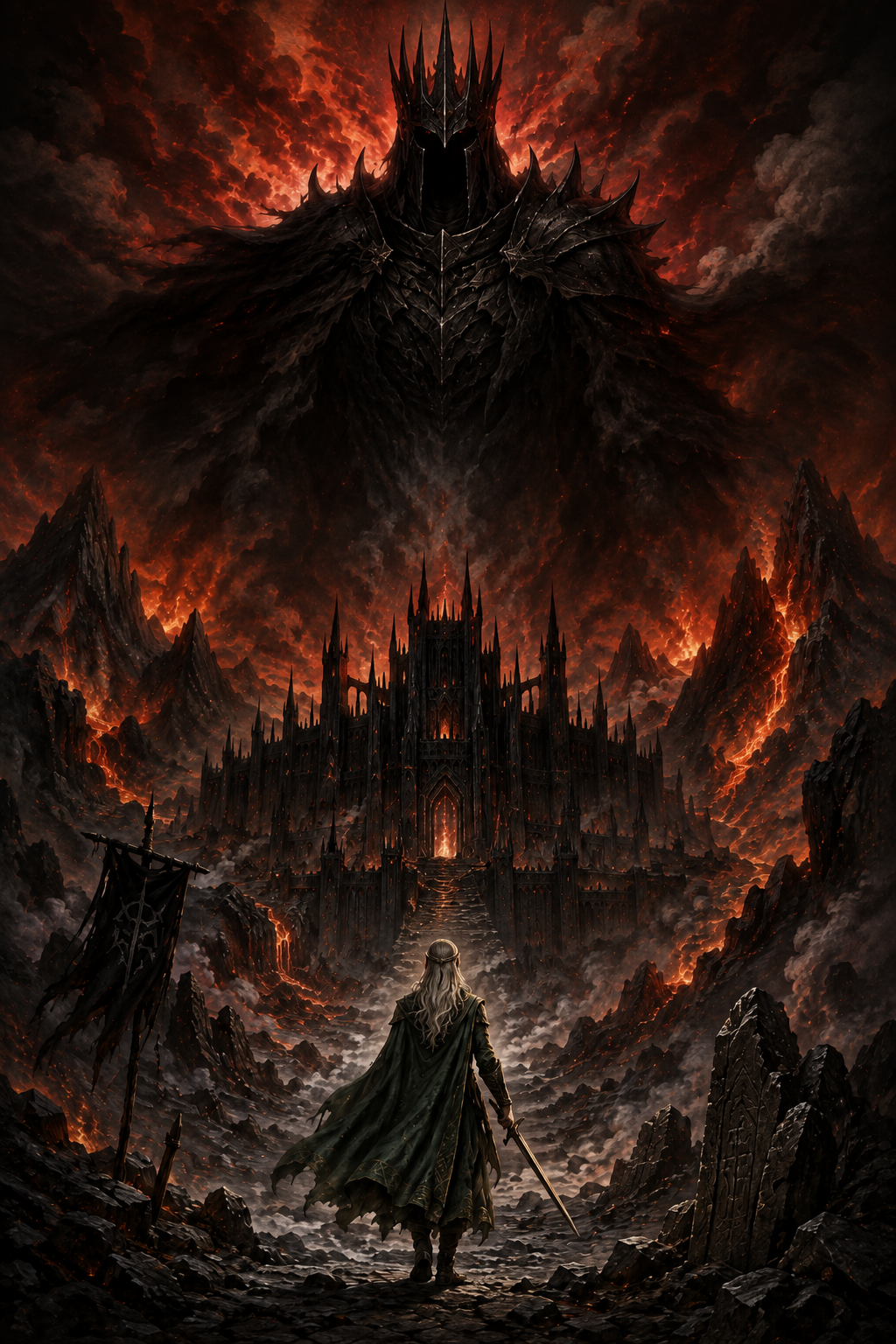

Welcome to Sil-Quest
A game of adventure set in the First Age of Middle-earth,
when the world still rang with elven song
and gleamed with dwarven mail.

Walk the dark halls of Angband.
Slay creatures black and fell.
Wrest a shining Silmaril from Morgoth’s iron crown.
- Welcome to Sil-Quest
- About this game
- About Sil
- The Basics
- Notes for Angband players
- About Sil-Q and Sil-Quest
- The Dungeon
- Race and House
- Stats
- Skills
- Combat
- User Interface
- Elements and Resistances
- Morale
- Stealth
- Smithing
- Temporary Status Effects
- Experience
- Abilities
- Sil-Quest Web and Mobile Notes
- Further Documentation
Sil-Quest is a fork of Sil-Q, which is itself a fork of the game Sil originally developed by Half and Scatha. In this document, the game Sil (v1.3) will be referred to as “original Sil”, when differences between the base game and the fork are noted. When the fork and base games are discussed as a whole, they will be referred to collectively as “Sil.”
Sil-Quest is based on Sil-Q. Sil-Quest-specific additions and updates in this document are licensed under the EUPL, Version 1.2 or subsequent versions of the EUPL. Portions adapted from the Sil-Q manual remain subject to the applicable licence and copyright terms of that source.
About this game
Sil-Quest is a fork of Sil-Q, which is itself a fork of Sil. If you know Sil or Sil-Q, much of the core dungeon-crawling experience will feel familiar: precise tactical combat, a sophisticated stealth system, morale, smithing, song, and the central impossible errand of stealing a Silmaril from Morgoth.
Sil-Quest keeps that foundation while adding a quest/scenario framework, web
support, mobile-oriented interface work, and cleanup of some legacy or unused
features. New authored content should generally be written as text scenarios
under lib/edit/quests/ rather than as binary savefiles.
This manual describes the Sil-Q-derived mechanics that Sil-Quest inherits, while
updating the framing to refer to Sil-Quest as its own game. For content-authoring
details, see the quest-authoring.adoc document.
About Sil
Sil is a role-playing game with a strong emphasis on discovery and tactical combat. Its combat system is simple to read but rich in consequences: heavy armour makes you easier to hit but reduces incoming damage, heavy weapons can overcome armour, and lighter weapons can favour accuracy and critical hits.
Sil is also unusually faithful to Tolkien’s First Age. It avoids many generic fantasy conventions: there are no wizards, priests, plate mail, fireball spells, or teleportation scrolls. Instead, warriors clad in mail sing songs of fear, binding, rage, sorrow, and escape.
Sil belongs to the roguelike tradition: randomly generated dungeons, permanent death, unidentified items, tactical resource pressure, and a compact symbolic interface. Sil-Quest adds a web frontend and semantic overlays, but the core roguelike bargain remains: choose carefully, because each character has one life.
Who will like Sil?
You may like Sil-Quest if you want a detailed, well-balanced tactical role-playing game; if you enjoy stealth and positioning as much as raw damage; or if you want a Tolkien-inspired game that feels less generic than most fantasy RPGs.
The Basics
You take the role of an elf, dwarf, or human attempting the impossible: infiltrate Morgoth’s fortress of Angband, descend one thousand feet into the cold earth, find Morgoth in his throne room, cut a Silmaril from his crown, and escape.
After character creation you begin just inside Angband with limited supplies. Your first task is to find a weapon, then secure equipment, develop skills, and learn which fights to seek, avoid, or end before they truly begin.
The best way to learn the basics is to play the tutorial. In game, press ? to
open help.
Dice notation uses XdY, meaning roll X dice with Y sides and add the
results. For example, 2d6 means two six-sided dice.
Notes for Angband players
Sil borrows much of Angband’s interface lineage, but most mechanics are changed.
                             ┌─> ...
      ┌──> Hack ──> Nethack ─┼─> ...
      │                      └─> ...
Rogue ┤
      │                      ┌─> ...
      └─> Moria ──> Angband ─┼─> Sil ──> Sil-Q ──> Sil-Quest
                             └─> ...
Main differences from Angband-style expectations include:
-
The goal is not simply to kill Morgoth.
-
The aim is to free a Silmaril from Morgoth’s crown, then escape.
-
The game is much shorter.
-
Morgoth is found at 1,000 ft.
-
There is no town or word of recall.
-
There are no classes or experience levels.
-
Character development is based on 8 skills and their ability trees.
-
Combat, stealth, morale, and monster AI are much more tactical.
-
Magic is subtle and thematic rather than spell-list driven.
-
There is an effective time limit: over time, you can no longer find your way back to shallower depths.
System differences include:
-
Strength, Dexterity, Constitution, and Grace replace the usual Angband stats.
-
Hit points do not rise with experience; they depend on Constitution.
-
There are four main elemental attack types: fire, cold, poison, and darkness.
-
Resistances stack, reducing damage to one half, then one third, then one quarter, and so on.
-
Darkness resistance is determined by light level.
-
Poison damages over time rather than as one direct hit.
-
Speed is less granular and less available.
-
{special}is the main pseudo-identification category for artefacts and enchanted items. -
Tunnelling requires shovels or mattocks.
About Sil-Q and Sil-Quest
Sil has many elegant ideas: stealth that matters, morale that changes how monsters behave, critical hits that make light and heavy weapons feel different, and distinct skill trees for smithing, song, perception, will, combat, and stealth.
Sil-Q refined many of Sil’s weaker elements. Sil-Quest starts from that refined base and then makes the game easier to maintain, author, and play in modern contexts, especially the browser.
More choices should be viable
Sil-Q removed or reworked many item and skill choices that were too weak, misleading, or narrow. Some weak items were removed or made useful. Some mechanics were introduced or adjusted so previously marginal weapons and builds could matter. Skills such as Impale and Vengeance support weapon and build classes that previously had little reason to exist.
Sil-Quest inherits that design direction. Its own cleanup work should follow the same principle: remove misleading options where possible, and make remaining options serve a clear gameplay purpose.
Morgoth should remain terrifying
Sil famously made killing Morgoth possible, even if thematically absurd. Sil-Q made Morgoth less of a hit-point mountain but more dangerous when angered. Sil-Quest keeps the theme that facing Morgoth should be a desperate act, not a routine optimization puzzle.
Skills should matter throughout the game
Several Sil skills were mainly valued for the throne room. Sil-Q replaced or rebalanced those so that investment in song, smithing, archery, stealth, and other trees could pay off during the whole descent. Sil-Quest should continue to treat skills as build-shaping tools rather than late-game tax payments.
A kinder start and better interfaces
Sil-Q made the early dungeon somewhat less punishing for players who had not yet mastered stealth and morale. Sil-Quest continues this accessibility direction at the interface layer: semantic web UI, mobile-friendly controls, contextual buttons, improved overlays, and scenario-authored tutorial content.
The Dungeon
"Far, far below the deepest delving of the Dwarves,
the world is gnawed by nameless things.”
Deep below Thangorodrim go the pits of Angband, and many and sprawling are the corridors and caverns. It is so vast and lacking in order that having once left an area behind, it is highly unlikely that you could navigate your way back.
Deep, deep within the earth, a thousand feet underground, is the throne room of the black enemy Morgoth. There he holds court with all manner of foul orcs, beasts, and demons, and in his black iron crown are those three stolen gems, the Silmarils of Fëanor. It is normally the greatest and darkest of his servants who are found in the deep parts of the dungeons.
Staircases and minimum depth
Staircases connect dungeon levels, but Sil’s descent is not a leisurely shopping trip. They normally take you 50 feet deeper or shallower, while shafts dive 100 feet into the rock. But the dark power of Morgoth calls all new things in Angband toward him, and you can resist that pull for only so long.
As time passes, the game raises your minimum depth. If you try to return above
that depth before claiming a Silmaril, the staircase collapses and you fall back
down instead. Your character sheet records this as Min Depth.
Only with a Silmaril in hand can you return all the way to the surface. The purpose of this rule is to stop slow accumulation of safety and power in the shallows: if you want the strength to face the throne room in time, you must press down toward the greater risks and rewards of the deep dungeon.
If you use many staircases in a short period, you may become lost and fail to arrive where expected. Monsters can also enter levels on staircases, making them dangerous places to linger while recovering from a fight.
Items and knowledge
Items often begin unidentified. Learning what objects do is part of play: potions, herbs, staves, horns, jewellery, enchanted equipment, artefacts, and curses all have knowledge states.
The most common way to identify an item is to cause it to have a visible effect. For example, drinking an unidentified Potion of Antidote while poisoned will identify that potion type for the rest of the game. Drinking the same potion while not poisoned teaches you nothing. Potions of Healing are a special case: they are identified the first time they are quaffed, even if no health is restored.
Knowledge-focused abilities can reveal item properties earlier. If you can make an item through smithing, you can identify that kind of item in the dungeon: Jeweller identifies jewellery, Alchemy identifies herbs, potions, staves, and horns, and Channeling identifies staves and horns. Staves of Understanding and Self Knowledge can also help. You still gain identification experience only when you actually encounter or identify new item types during play.
Race and House
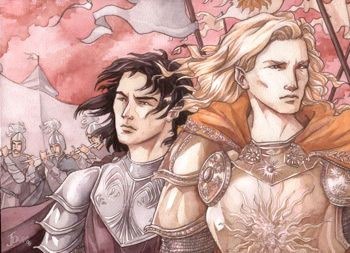
Race and house define your starting identity and shape your stats, affinities, masteries, penalties, and weapon proficiencies.
The races are intentionally not balanced against one another. The Noldor are the most forgiving and are a good first choice. The Naugrim and Sindar are somewhat harder but encourage interesting variations in play. The Edain are noticeably more difficult and should be treated as a challenge mode. Within a race, the houses are intended to be roughly comparable in power.
Each race and house modifies Strength, Dexterity, Constitution, and Grace. It may also grant affinities, masteries, penalties, or weapon proficiencies:
Affinity-
Gives +1 to the skill total. Abilities in that tree cost 500 experience less, and the first ability in the tree is free.
Mastery-
Acts like a double affinity for one skill: +2 to the skill total, abilities cost 1000 experience less, and the first ability is free.
Penalty-
Gives -1 to the skill total and makes abilities in that tree cost 500 experience more.
Weapon proficiency-
Gives +1 with a weapon family while the appropriate weapon is used. Elves have bow proficiency; dwarves have axe proficiency.
Elves inherit bow proficiency and song affinity rather than blade proficiency and bow affinity. This helps balance archery and makes songs more available.
Stats
Sil-Quest inherits the Sil-Q stat model. Strength, Dexterity, Constitution, and Grace remain the four primary stats. In the main game you have 13 points to spend between them at character creation. Costs follow the triangular numbers: 1, 3, 6, 10.
Strength-
Increases melee damage, though this bonus is limited by weapon weight. It also increases bow range, carrying capacity, throwing range, heavy weapon handling, resistance to disarming, escaping webs, and bashing down locked doors.
Dexterity-
Gives a bonus to the first four skills: Melee, Archery, Evasion, and Stealth. It also helps avoid needle traps in chests.
Constitution-
Determines health. Each point increases health by 20%.
Grace-
Gives a bonus to the last four skills: Perception, Will, Smithing, and Song. Each point increases Voice by 20%.
“But of bliss and glad life there is little to be said, before it ends;
as works fair and wonderful, while they still endure for eyes to see,
are ever their own record, and only when they are in peril or broken
for ever do they pass into song.”
Skills
Skills are the main form of character development. You spend experience to raise skill values, then buy abilities from the associated ability trees.
The main mechanic in Sil-Quest is the skill check. For most checks, you roll
1d10 + skill and compare it against 1d10 + difficulty; your total must be
higher to succeed. For Melee, Archery, and Evasion, the game uses 1d20 instead
of 1d10, making combat swingier and allowing dramatic critical hits.
Skill checks are often opposed by an enemy skill. Melee attacks oppose enemy Evasion, stealth opposes enemy Perception, and many songs or status effects oppose enemy Will. Your skills can be viewed and improved from the character menu.
Stealth
Stealth helps you avoid being noticed. It is opposed by monster Perception and is modified by distance, doors, noise, armour weight, combat, songs, and recent actions. Stealth mode gives +5 Stealth but lowers speed by 1.
Compared to original Sil, early creatures tend to have lower perception, while deeper creatures tend to have higher perception and will. This represents Morgoth’s creatures becoming more aware of the player as the descent continues.
Perception
Perception helps you notice traps, secret doors, and invisible opponents. It also helps disarm traps and pick locks.
Trap and secret-door detection uses a base of half the dungeon level, plus 10 for floor traps and secret doors, 15 for chest traps, 5 if you cannot see properly, 5 if confused, and 2 for each square of distance beyond the first. Disarming and lock-picking use the trap or lock’s own difficulty, with extra penalties for locks, poor sight, and confusion. If you fail to disarm a trap by 3 or more, you trigger it.
Will
Will helps resist many special effects: confusion, stunning, fear, blindness, entrancement, slowing, hallucination, hunger, and stat draining. If an enemy caused the effect, the difficulty is often based on that enemy’s Will; otherwise the default difficulty is usually 10.
Will also helps you use staves and horns, and increases the effectiveness of many of them.
Smithing
Smithing was substantially reworked in Sil-Q and remains central in Sil-Quest. Guaranteed forges exist at important depths, and armour and weapons can have their basic stats modified without needing the old Artistry skill. Protection is cheaper, evasion and accuracy are more expensive, and high-tier effects carry higher costs.
Melee
Melee governs close combat accuracy and many physical combat abilities.
Archery
Archery governs bow attacks and ranged ability investment.
Evasion
Evasion is the primary defensive skill against physical attacks.
Song
Song powers the subtle magic of Sil-Quest: fear, revelation, silence, healing, warding, protection, mastery, and layered themes.
Combat
Each attack has two stages: first the game checks whether the blow hits, then it checks how much damage gets through.
Weapons and armour display compact combat notation:
-
Offense comes first and is written in round brackets:
Battle Axe (-3,3d4). This axe gives -3 accuracy and rolls3d4damage when it hits. -
Defence comes second and is written in square brackets:
Leather Armour
[-1,1d4]
. This armour gives -1 Evasion and absorbs1d4damage. -
Some items have both offensive and defensive modifiers. For example,
Greatsword (-2,3d5) [+1]gives an attack penalty, a damage roll, and an Evasion bonus from parrying. -
Armour can also penalize offense:
Mail Corslet (-1) [-3,2d4]gives -1 to attacks, -3 to Evasion, and2d4protection.
Some weapon stats differ from original Sil, especially where old weapons were weaker than starting equipment.
Attacking
To see whether a melee attack hits, the attacker rolls:
attacker's Melee + 1d20The defender rolls:
defender's Evasion + 1d20If the attack roll is greater, the attack hits. Melee and Evasion scores include weapon and armour modifiers, status effects such as stunning, and relevant abilities.
Being surrounded is extremely dangerous. Overwhelming affects only Evasion: enemies on the far side of the attacker contribute larger penalties than enemies near the attacker, and even weak monsters can become deadly once they surround you. Monsters never suffer this penalty, since there is only one of you.
Visibility also matters. If an attacker cannot see the defender, the attacker’s Melee is halved. If the defender cannot see the attacker, Evasion is halved. Unwary enemies count as unable to see you for this purpose. Fighting from a pit or web halves both Melee and Evasion again. A creature unable to move, such as a sleeping enemy or an entranced player, has Evasion set to -5 regardless of other modifiers.
Damage
If an attack hits, the attacker rolls damage and the defender rolls protection. If damage is less than or equal to protection, no damage is dealt. Otherwise the target takes one point of damage for each point by which damage exceeds protection.
Strength adds sides to weapon dice, limited by weapon weight. A character with
Strength 3 using a 3d4 battle axe would normally roll 3d7; if the axe weighs
only 4 lb, no more than four Strength-derived sides can be added. Negative
Strength subtracts sides under the same limit.
Hand-and-a-half weapons can be used one-handed or two-handed. If you are not using a shield, the game assumes you are wielding such a weapon two-handed and adds two damage sides.
Extra damage dice come mainly from slays, brands, and critical hits. A slaying weapon adds a die against the relevant enemy. Elemental brands add a die against enemies that do not resist the element, and two dice against enemies that are explicitly vulnerable to it.
Critical hits reward high accuracy and lighter weapons. The first critical die requires beating the Evasion roll by:
7 + weapon weightEach additional multiple of that amount adds another die. A 3 lb longsword therefore needs to beat Evasion by 10 for the first bonus die, 20 for the second, 30 for the third, and so on.
Archery
Archery is similar to melee, but uses the Archery skill, adds the arrow’s attack bonus, and suffers -1 for every 5 squares of range. The defender’s Evasion is halved against archery, which can stack with other halvings.
Bow damage uses Strength, slays, brands, and critical hits much like melee.
Strength is limited by bow weight. Bow range is 1.5 times the number of damage
sides; a longbow dealing 1d10 has range 15.
Firing while enemies are adjacent is dangerous. Unless an ability says otherwise, adjacent enemies get free attacks against you at half your normal Evasion.
Thrown weapons
Throwing is also melee-like, but many objects are not designed to be thrown. Daggers, throwing axes, and spears are suitable throwing weapons; unsuitable objects suffer -5 to hit. All throws suffer -1 attack per 5 squares.
Damage sides are halved if the object was not designed for throwing. Range is based on the object’s weight and your carrying capacity:
carrying capacity / (5 * (weight + 2))Thrown weapons display their range when examined.
Consumables, horns, and special items
Consumables include herbs, potions, and staves. Horns are also found in Angband; unlike staves, horns do not run out of charges, but cost Voice when blown.
Each run randomizes the visible descriptions of unidentified consumables. A healing potion that was golden in one game may be purple in the next, but once a description is identified it remains consistent for that run.
Special items include ego items and artefacts. Slaying weapons and other special equipment are identified by seeing their effects. Artefacts are generated only once, when a floor is created; if you leave that floor without finding or identifying one, that artefact will not be generated again in that run.
User Interface
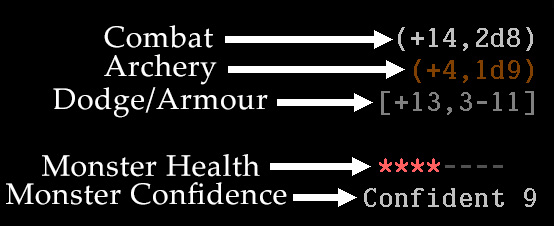
The traditional interface presents compact combat, archery, evasion/protection, monster health, and monster morale information. Sil-Quest’s web frontend re-renders much of this information semantically, but the underlying concepts are the same.
In native terminal-style frontends, additional windows can show information such as combat rolls, inventory, and messages. In the web frontend, these become panels, overlays, and contextual controls.
Save files
Sil-Quest supports ordinary save/load for the main game. Traditional Sil options are tied to a character name, so a new character name starts with its own option state. Some players therefore reuse names across attempts.
Some quests, especially tutorial or challenge-style scenario content, may be
marked NO_SAVE and should not be persisted in deployment builds.
Elements and Resistances
Elemental attacks include fire, cold, poison, and darkness.
Fire-
The most common and dangerous element. It can destroy arrows, bows, axes, polearms, hafted weapons, boots, gloves, cloaks, soft armour, chests, torches, and staves.
Cold-
Less common than fire. It can destroy potions and flasks of oil.
Poison-
Damages over time rather than as one immediate burst. Poison damage is added to a poison counter; each round, about 20% of the remaining counter is dealt as damage and removed from the counter.
Darkness-
Is resisted through light. There is no ordinary darkness resistance; instead, light level above 2 grants one level of darkness resistance for each excess point.
Resistances stack: one source reduces damage to one half, two to one third, three to one quarter, and so on.
Elemental attacks can be pure, like dragon breath and poison gas, or mixed with physical damage, like a balrog’s flaming sword. Mixed elemental damage adds an extra damage die if you lack resistance, or two extra dice if you are especially vulnerable. Multiple sources of resistance do not further reduce mixed elemental damage.
Breath attacks spread in a cone and lose 2d4 damage per square travelled.
Armour usually does not protect against them; only special protection from
abilities, magical rings and amulets, and sometimes shields against fire or cold,
are counted before resistance divides the remaining damage.
Morale
Sil-Quest inherits Sil-Q’s correction to Majesty: Majesty lowers morale by half the difference between your Will and the monster’s Will, not by -1 per 4 points of player Will.
Monsters are not just bags of hit points. Their morale changes as they are wounded, see allies die, notice you, hear songs, or face a character of great majesty. A monster may be aggressive, confident, wavering, or fleeing. Learning to make enemies flee, or to keep them from becoming confident, is part of the tactical game.
Most enemies evaluate the situation instead of always fighting to the death. Mindless creatures are the main exception. Morale begins with a base value and then rises or falls with circumstances.
Morale bonuses include:
-
the base morale value;
-
appearing later than the monster’s usual depth;
-
the player escaping Angband with a Silmaril;
-
the player being blind, hallucinating, stunned, confused, slow, afraid, entranced, or knocked out;
-
the player being wounded, especially below half or quarter health;
-
the monster being hasted;
-
similar nearby creatures that are not fleeing, especially leaders.
Morale penalties include:
-
appearing earlier than the monster’s usual depth;
-
the monster being stunned or badly wounded;
-
light-susceptible monsters standing in strong light;
-
Majesty, based on the difference between your Will and the monster’s Will;
-
Bane, against the selected enemy category;
-
similar nearby creatures fleeing, especially leaders.
Temporary morale modifiers decay by about 10% each turn. They include being unable to escape, just starting or stopping flight, seeing similar creatures killed, being struck by slays or especially harmful brands, suffering Cruel Blow, hearing Song of Elbereth, or being affected by Horns of Terror and Staves of Majesty.
The resulting morale determines stance:
Aggressive-
High morale. The monster attacks directly. Mindless creatures, trolls, angered enemies, and creatures affected by wrath use Aggressive behaviour instead of ordinary confidence.
Confident-
Positive morale. The monster may use tactics while engaging you, such as waiting in rooms or choosing favourable approaches.
Fleeing-
Morale of 0 or less. The monster tries to get away. Creatures immune to non-magical fear stay confident instead of fleeing.
Stealth
In the tale behind Sil, Beren and Luthien enter Angband through secrecy and song, not by cutting down every guard. Sil-Quest keeps stealth as a first-class way to play.
Monster alertness broadly moves through these states:
Asleep-
The monster is unaware and vulnerable.
Unwary-
The monster is awake but has not fully noticed you.
Alert-
The monster has noticed you and can act against you normally.
Internally, monster awareness is tracked as an Alertness score. An Alertness of 0 or more means the monster is aware of you. From -1 to -10 it is awake but unwary. At -11 or below it is usually asleep, though not every creature in Angband sleeps.
Each round, you roll:
your Stealth + 1d10Each monster rolls:
monster Perception + 1d10If the monster’s total is higher, its Alertness rises by the difference. This can wake sleeping enemies, make unwary enemies alert, or draw hostile attention.
Helpful stealth factors include:
-
distance from the monster;
-
closed doors between you and the monster;
-
Stealth mode, which gives +5 Stealth but lowers speed;
-
passing a turn, which gives a larger temporary quietness bonus that does not stack with Stealth mode.
Hindrances include:
-
armour weight;
-
attacking or being attacked;
-
unwary monsters seeing you in line of sight;
-
being in open spaces with many adjacent passable squares;
-
singing, based on the song’s noise value;
-
setting off traps;
-
landing from a leap.
Your light level does not directly penalize Stealth. Stealth is abstract: it can mean moving quietly, keeping to shadow, making noises that blend into the dungeon, or simply not being where enemies expect you to be.
If you attack a monster, or an unaware monster tries to move into your square, it notices you immediately. Once a monster has noticed you, it can become unwary again only if you are out of sight and it fails its perception check badly enough. This normally requires beating it by more than 25; Vanish reduces this threshold to 15. Songs, staves, and territorial behaviour can also make monsters unwary or asleep.
Compared to original Sil, Sil-Q and Sil-Quest make early monsters less perceptive and deeper monsters more perceptive and willful.
Smithing
Angband contains forges used by Morgoth’s hosts, and a skilled character can turn them to other purposes. Smithing requires:
-
a forge with remaining uses;
-
the relevant Smithing ability;
-
the base object or category you want to make;
-
sufficient Smithing skill for the planned difficulty;
-
any required experience, stat, or special costs.
Making an item takes ten turns per point of difficulty and makes noise, so you may be interrupted. Interrupted forging can be resumed later at the same forge. You can use smithing planning mode at a forge to explore possibilities before committing resources.
Some equipment slots are easier to enchant than others. Weapons, bows, shields, body armour, helms, and amulets have lower costs than most other slots, and robes are cheaper still. In the main dungeon, there are guaranteed forges at 100 ft, 300 ft, and 500 ft, but only the first time those depths are generated. If a shaft skips over such a depth, the guaranteed forge appears at the depth where you land instead.
Sil-Quest inherits Sil-Q’s guaranteed important forges and its smithing cost rebalance. Protection is cheaper, Evasion and accuracy are more expensive, and high-tier effects cost more experience. Authored scenarios can also place forges directly in map terrain.
Creating artefacts
With Artifice, truly great smiths can make custom artefacts: beautiful or terrible works that may become the matter of songs and legends. Artefacts can combine properties beyond the usual limits, can be named by the player, and are almost indestructible. Creating one is a great work and requires three uses from the same forge.
Enchanted forges
Most forges arm Morgoth’s hosts with swords and mail, but a few are greater works used for the axes of Valaraukar or the armour of mighty trolls. Enchanted forges give a Smithing bonus, allowing you to create items beyond your ordinary reach.
Temporary Status Effects
At certain times you may suffer temporary effects. Many appear in coloured text near the bottom of the map or in the web status area. Most wear off with time, and many have some consumable or ability that can remove them immediately.
Hunger
The Gorged status no longer exists. Characters may still eat and drink when maximally full, but after the message that they are as full as possible, additional food is digested extremely rapidly.
Hunger states are:
Full-
At least 5,000 turns of food.
Hungry-
Below the comfortable range, but not yet dangerous.
Weak-
Around 1,000 turns of food or less. You suffer -1 Strength until you eat enough to recover.
Starving-
No food remains. You take damage each turn and no longer regenerate health.
Negative effects
Blind-
You cannot see. Melee, Evasion, and Archery are halved against foes you cannot see.
Hallucinating-
Enemies and objects appear as other things, and you may occasionally see things that are not there.
Slow-
You move at half speed. If this is caused by excessive carried weight, you must reduce your load to remove it.
Confused-
You cannot reliably choose directions. Directional actions may go somewhere nearby instead.
Afraid-
You are too afraid to attack by melee, archery, or throwing.
Entranced-
You cannot act and have -5 Evasion. It can be broken by an enemy attack, time, or Freedom of Movement.
Stunned-
Stunned characters suffer -2 to all skills. Heavy stunning worsens this to -4. Extreme stunning can knock the character out, leaving them unable to act with -5 Evasion.
Poisoned X-
You will take
Xpoison damage over the next few rounds. Each round, about 20% of the remaining amount is dealt and removed. Bleeding X-
An open wound, handled similarly to poison.
Drained stats and resistances
Drained Strength, Dexterity, Constitution, or Grace appears in yellow. Stat drain does not heal with time; you need an appropriate item to restore it.
Elemental resistances are covered in the elements section. Resistance to a status effect grants a large bonus, usually +10, to rolls against that effect. Free Action resists slowness and entrancement and helps escape webs. See Invisible grants +10 to seeing otherwise invisible enemies.
Regeneration
Regeneration increases hunger only while you are actually regenerating. Voice recovery is also affected by regeneration. In practice, regeneration heals you at three times the normal rate and improves Voice recovery, but makes you hungry much faster while it is active.
Experience
Sil has neither classes nor experience levels. Experience is spent directly on skills and abilities.
Common sources of experience include:
-
encountering new monster types;
-
killing monsters;
-
descending deeper;
-
identifying new item types;
-
some scenario or quest-specific rewards.
In the ordinary main game, characters begin with 5,000 experience to allocate.
Sil-Q introduced a Fixed XP challenge with 50,000 starting experience and no
further experience gain. Sil-Quest has moved toward quest/scenario-backed starts
instead; scenario-authored quests can set starting experience explicitly with
P:EXP and P:NEW_EXP.
In ordinary main-game play, experience follows the Sil-Q model.
Encountering a monster for the first time gives experience based on the depth at which that monster is normally found. Later encounters with the same monster type decay: the second gives half, the third gives a third, the fourth gives a quarter, and so on. Killing monsters gives a separate pool of experience using the same decay. There is as much experience available from encounters as from kills, so stealthy characters can progress without needing to murder every room into silence.
The first time you reach a depth of d feet or deeper, you gain d experience.
Identifying a new potion, herb, ring, amulet, horn, stave, or special item gives
100 experience; identifying an artefact gives 200.
You spend experience to improve the eight skills. Your first point in a skill costs 100 experience, your second costs 200, your third costs 300, and so on. Abilities linked to a skill become more expensive as you buy more of them: the first costs 500, the second 1000, the third 1500, and so forth, modified by affinities, masteries, and penalties.
“As three great Jewels they were in form. But not until the End,
when Fëanor shall return who perished ere the Sun was made,
and sits now in the Halls of Awaiting and comes no more among his kin;
not until the Sun passes and the Moon falls, shall it be known
of what substance they were made.”
Abilities
This section is a reference for the Sil-Q-derived ability set inherited by Sil-Quest.
Melee Abilities
Power
-
Gives +1 damage side to melee attacks.
-
Increases the amount needed to score each level of critical hit by 1.
-
For example, you need to hit by
8 + weapon weightinstead of7 + weapon weight.
-
Finesse
-
Lowers the amount needed to score each level of critical hit by 2.
-
For example, you need to hit by
5 + weapon weightinstead of7 + weapon weight.
-
This was strengthened from Sil, where it reduced the amount needed by 1.
Knock Back
-
When you hit a monster, you make a skill check to see whether you force it back one square.
-
You roll twice your effective Strength with that attack against twice the monster’s Constitution.
-
Effective Strength includes ability modifiers such as Charge or Rapid Attack, is capped by weapon weight, and gets +2 if wielding a weapon with two hands.
-
The monster is knocked back only if an empty square is available.
-
A monster actually moved by Knock Back misses its next turn.
-
Opportunist attacks do not trigger Knock Back.
Polearm Mastery
-
Gives +2 Melee when using polearms.
-
Allows you to set a polearm to intercept attackers.
-
If you waited last turn and an opponent who was not adjacent moves adjacent, you get a free attack.
-
You do not get this free attack if you cannot see the opponent or are confused.
-
Charge
-
If you attack after just moving toward an opponent, your attack is calculated as if you had +3 Strength and +3 Dexterity.
-
The damage bonus applies only to regular, flanking, or controlled-retreat attacks.
Follow-Through
-
If you kill an opponent, you get a free follow-through attack on another adjacent opponent.
-
You do not get the free attack if you cannot see the opponent or are confused.
-
The follow-up applies only after a regular, flanking, controlled-retreat, or follow-through attack, so it can chain.
Impale
-
Allows you to attack up to two enemies in a row while wielding a polearm or greatsword.
-
Both enemies are attacked with an impale attack.
-
Applies only if the attack was regular, flanking, or controlled retreat.
-
Rapid Attack and Smite can trigger on Impale attacks.
Subtlety
-
If you wield a one-handed weapon and have nothing in your off-hand, the amount needed for each critical-hit level is reduced by 2.
-
Hand-and-a-half weapons, such as Bastard Swords, do not count as one-handed.
This stacks with Finesse.
Whirlwind Attack
-
When you attack an enemy, you get a free attack on all other adjacent enemies.
-
You do get these free attacks even if you cannot see the opponent or are confused.
-
Extra attacks are gained only on regular, flanking, or controlled-retreat attacks.
-
All the attacks are treated as whirlwind attacks, so they are incompatible with many other abilities.
Zone of Control
-
If an opponent moves between two squares that are both adjacent to you, you get a free attack.
-
You do not get this free attack if you cannot see the opponent or are confused.
Smite
-
When using a two-handed weapon, the first main attack you make each turn rolls maximum possible damage against all opponents it hits.
-
If you make such an attack, you lose a turn recovering.
-
Whirlwind Attack and Impale count as main attacks that can hit multiple enemies.
Two Weapon Fighting
-
You can wield a one-handed weapon in your off-hand instead of a shield.
-
You receive an off-hand attack calculated as if you had -3 Strength and -3 Dexterity.
-
The extra attack applies only to regular, flanking, whirlwind, or controlled-retreat attacks.
-
If Impale and Two Weapon Fighting would both be valid, you impale instead of striking with both weapons.
Rapid Attack
-
You receive two melee attacks instead of one.
-
They are calculated as if you had -3 Strength and -3 Dexterity.
-
The extra attack applies only to regular, flanking, or controlled-retreat attacks.
-
In other cases, the single attack does not suffer those penalties.
Strength
-
You gain a point of Strength.
Archery Abilities
Rout
-
Attacks on fleeing enemies are calculated as if you had +5 Dexterity.
Fletchery
-
You can craft arrows into +3 arrows with the
-command. -
Each +3 arrow takes one turn to craft.
-
Crafting a whole stack takes as many turns as there are arrows.
-
You can be interrupted while crafting.
Point Blank Archery
-
When firing provokes attacks of opportunity, the enemy you fired at does not get one.
Puncture
-
Whenever an enemy’s armour roll would fully block your archery damage roll, you deal a flat 5 damage instead.
Ambush
-
Grants an additional critical damage die when you hit an unwary or sleeping monster with an arrow.
Versatility
-
If Archery is higher than Melee, you gain a Melee bonus equal to half the difference, rounded down.
Crippling Shot
-
If you score a critical hit with archery and deal at least 1 net damage, the target makes a Will check against:
30 - (60 / (critical level + 2)) -
On failure, the target is slowed for one round per critical level.
Deadly Hail
-
When shooting an enemy immediately after killing another enemy with an arrow, you roll twice as many damage dice as normal.
-
All damage dice are doubled: slay, poison, critical, and weapon dice all count.
-
The target only rolls armour once.
Dexterity
-
You gain a point of Dexterity.
Evasion Abilities
Dodging
-
Gives +3 Evasion if you moved last turn.
-
This bonus is not shown in the side panel, but it applies.
Blocking
-
Doubles the number of protection dice granted by your shield against all attacks if you did not move on your last turn.
Parry
-
Doubles the evasion bonus granted by your weapon.
-
This does not apply to an off-hand weapon.
Crowd Fighting
-
Halves the Melee bonus opponents get for surrounding you.
Leaping
-
Lets you leap over one square of chasm or trap.
-
Roosts and webs are not leapable.
-
You must have moved roughly toward the obstacle on the previous turn.
-
It takes two turns to reach the destination; one is spent in the air.
-
You can be attacked while in the air.
Sprinting
-
You gain +1 speed if you move four or more squares in roughly the same direction.
-
Each move can differ by up to 45 degrees from the previous one.
-
The speed lasts until you fail to meet the condition.
-
You can never exceed speed 3.
Flanking
-
Gives a free attack if you move between two squares that are both adjacent to an opponent.
-
You cannot get both a flanking attack and a controlled-retreat attack in the same turn; flanking only adds eligible opponents.
-
Works on one opponent each time, preferring the targeted opponent if any.
-
You do not get the free attack if you cannot see the opponent or are confused.
Heavy Armour Use
-
Gives
[1dX]extra protection, whereX = total armour weight / 15 lb.
Riposte
-
If an opponent misses you in melee by at least
10 + weapon weight, you get a free attack. -
You get at most one riposte per round.
-
You do not get this free attack if you cannot see the opponent or are confused.
Controlled Retreat
-
Gives a free attack if you move from a square adjacent to an opponent to a square not adjacent to it, but only if you did not move on the previous round.
-
You cannot get both a flanking attack and a controlled-retreat attack in the same turn; controlled retreat only adds eligible opponents.
-
Works on one opponent each time, preferring the targeted opponent if any.
-
You do not get the free attack if you cannot see the opponent or are confused.
Dexterity
-
You gain a point of Dexterity.
Stealth Abilities
Disguise
-
Halves bonuses that awake but unwary monsters have to notice you because you are in their line of sight.
Assassination
-
Gives a Melee bonus equal to your Stealth when attacking unwary or sleeping opponents.
-
You do not get the bonus if you cannot see the opponent or are confused.
-
The bonus applies only to regular, flanking, or controlled-retreat attacks.
-
The bonus is not applied to charge attacks.
Cruel Blow
-
If you score a critical hit in melee and deal at least 1 net damage, the target makes a Will check against:
30 - (60 / (critical level + 2)) -
On failure, the target becomes confused with pain for one round per critical level.
Exchange Places
-
Use the
Xcommand to swap places with an adjacent enemy. -
Alert enemies get a free attack unless they are confused or mindless.
-
Cannot be used when you cannot see the enemy, or while you are in a web or pit.
Opportunist
-
If an opponent moves from a square adjacent to you to one that is not, you get a free attack.
-
You do not get the free attack if you cannot see the opponent or are confused.
Vanish
-
Makes it easier to make enemies unwary again.
-
Instead of needing to beat their perception check by more than 25 while out of line of sight, you need to beat it by more than 15.
Dexterity
-
You gain a point of Dexterity.
Perception Abilities
Quick Study
-
Lets you take abilities without their normal prerequisite abilities.
Focused attack
-
Gives an attack bonus equal to half your Perception if you waited on the previous turn.
-
Works only for the first attack of the round.
Keen Senses
-
Lets you see enemies just beyond the edge of a pool of light, including your own light radius.
-
Gives +5 to spotting invisible enemies.
Concentration
-
Gives +1 attack for each consecutive round spent attacking a particular enemy, to a maximum of half your Perception.
-
Waiting or blocking does not break concentration.
Alchemy
-
Reveals the purpose of all herbs and potions you encounter, as well as staves and horns.
-
You still gain identification experience only when you actually encounter an item type you had not seen before.
Bane
-
Gives a bonus to all skill rolls against a selected broad enemy category.
-
Categories are Orc, Wolf, Spider, Troll, Wraith, Rauko, Serpent, and Dragon.
-
You must have killed 4 enemies from the category to select it.
-
When you reach
2nkills of the chosen enemy, the bonus increases to+n.
Outwit
-
Whenever you receive a critical hit, you make a Perception roll against the attacker’s Perception.
-
If you succeed, you negate all critical damage from that attack.
Listen
-
Gives a chance each turn to detect monsters you cannot see, including around corners and through doors.
-
The check is Perception versus the opponent’s stealth score with a modifier, as below:
-
-3if awake but unwary -
-5if it moved -
-10if it called out or smashed a door -
-15if it tunnelled through rock -
+(Song / 2)if you are singing Song of Silence -
+1per square of distance along the shortest sound path -
+5per closed door along the shortest sound path
-
-
Success represents the opponent as a grey asterisk.
-
Success by 10 or more reveals the opponent completely.
Master Hunter
-
Gives +1 attack for each time you have killed an opponent of the same narrow type, up to a maximum of one half of your Perception.
-
For example, killing 3 Orc soldiers gives +3 attack against Orc soldiers.
Grace
-
You gain a point of Grace.
Will Abilities
Curse Breaking
-
Lets you remove cursed equipment and thereby break the curse.
Channeling
-
You automatically recognize all staves and horns.
-
Horns have halved voice costs.
-
Staves have twice as many charges.
Strength in Adversity
-
Gives bonuses to Strength, Dexterity, and Grace when seriously injured:
-
+1 at 50% health or below.
-
+3 at 25% health or below.
-
Formidable
-
Slaying enemies in melee scares all other enemies who see it.
-
Enemies do not gain morale based on your injuries.
Inner Light
-
Strengthens the light in your light radius against unnatural darkness created by some monsters.
Indomitable
-
Gives resistance to fear, confusion, stunning, and hallucination.
-
Slows hunger to one third the normal rate.
Oath
-
You swear an oath and are rewarded for keeping it.
-
If the forbidden action has already been performed before the oath is taken, that oath is unavailable.
-
If you perform the forbidden action after taking the oath, you lose the oath’s benefit and cannot recover it that game.
-
Oaths:
-
Mercy: do not attack Men or Elves; gain +1 Grace.
-
Silence: do not sing; gain +1 Strength.
-
Iron: do not go up stairs without a Silmaril; gain +2 Constitution.
-
Poison Resistance
-
Gives a level of resistance to poison.
Vengeance
-
When damaged in melee by an enemy, your next successful attack gains one additional damage die.
-
This does not stack.
-
A maximum of one die can be gained this way on each attack.
Majesty
-
Makes monsters more likely to flee by lowering morale by half the difference between your Will and theirs.
Constitution
-
You gain a point of Constitution.
Smithing Abilities
Weaponsmith
-
Allows you to create weapons at a forge.
-
Includes bows and arrows.
-
Lets you improve attack, evasion, and damage values of weapons you create.
Armoursmith
-
Allows you to create armour at a forge.
-
Lets you improve attack, evasion, and protection values of armour you create.
Jeweller
-
Allows you to create rings, amulets, light sources, and horns at a forge.
-
Identifies rings, amulets, light sources, and horns you encounter.
Enchantment
-
Allows you to create
{special}items at a forge. -
Identifies enchanted items you encounter.
Expertise
-
Reduces time taken to forge an item by half.
-
Negates all experience and stat costs on items you create.
Artifice
-
Allows you to create custom artefacts with many different properties.
-
These require three forge uses each.
Masterpiece
-
Allows you to create items whose difficulty exceeds your Smithing skill.
-
For each excess point of difficulty, you permanently lose one Smithing point.
-
You can regain lost Smithing later with more experience.
Grace
-
You gain a point of Grace.
Song Abilities
“Then sudden Felagund there swaying
sang in answer a song of staying,
resisting, battling against power,
of secrets kept, strength like a tower,
and trust unbroken, freedom, escape;
of changing and of shifting shape,
of snares eluded, broken traps,
the prison opening, the chain that snaps.”
Song of Elbereth
-
Causes fear in intelligent enemies.
-
Uses a Song skill check versus the
enemy Will, with a modifier as below:-
+1per square of distance along the shortest sound path -
+5per closed door along the shortest sound path
-
-
Temporarily lowers morale by 1 per point you succeed by.
-
Voice: 1/3 per turn.
-
Noise: 8.
Song of Challenge
-
Boosts enemy morale and makes enemies aggressive.
-
Morale is boosted by up to +3.
-
Enemies with morale greater than 5 become aggressive.
-
Aggressive enemies that would normally attack at range or keep distance may be angered into charging.
-
Uses a Song skill check against
(enemy Will * enemy Will) / 10, with modifiers:-
+1per square of distance along the shortest sound path -
+5per closed door along the shortest sound path
-
-
Voice: 1/3 per turn.
-
Noise: 12.
Song of Delvings
-
Reveals terrain adjacent to known areas, including forges, stairs, traps, and secret doors.
-
Squares adjacent to known squares are revealed if:
Song - distance from player > 1d6 -
Stairs and forges do not need to be adjacent to a wall to be seen.
-
Voice: 1/3 per turn.
-
Noise: 4.
Song of Freedom
-
Eases passage through the dungeon.
-
Grants free action, protecting from entrancement and slowing.
-
Makes existing entrancement and slowing effects wear off quickly.
-
Can disarm nearby traps, remove rubble, discover secret doors, and unlock locked or stuck doors and chests.
-
Uses a Song skill check versus
dungeon level / 2 + 5, with modifiers:-
+1per square of distance along the shortest sound path -
+5per closed door along the shortest sound path
-
-
Voice: 1/3 per turn.
-
Noise: 4.
Song of Silence
-
Quietens dungeon sounds, making opponents less likely to notice you.
-
Lowers the noise you make by half your Song skill.
-
Also affects opponents hearing each other call for help.
-
Also penalizes your own Listen ability.
-
Voice: 1/3 per turn.
-
Noise: 0.
Song of Staunching
-
Stops bleeding and speeds wound healing.
-
Each point of Song heals 1/12 health per turn.
-
Voice: 1 per turn.
-
Noise: 4.
Song of Thresholds
-
Doors you close while singing are warded.
-
Warded doors can be green, blue, or purple.
-
Green wards require a 20-strength Will check to pass.
-
Blue wards require a 25-strength Will check to pass.
-
Purple wards require a 30-strength Will check to pass.
-
-
Ward strength is determined by a
1d10Song check with difficulty 15.-
Failure creates a green ward.
-
Success creates a blue ward.
-
Success by 10 or more creates a purple ward.
-
-
Voice: 1/3 per turn.
-
Noise: 4.
Song of the Trees
-
Increases light radius by 1 per 5 Song.
-
Voice: 1/3 per turn.
-
Noise: 4.
Song of Slaying
-
Critical hits in melee kill enemies outright if they have health less than or equal to twice your Song score.
-
Voice: 1 per turn.
-
Noise: 8.
Song of Staying
-
Gives
[2d2]protection against all damage types. -
Increases Will by 1 for every 2 points of Song.
-
Voice: 1 per turn.
-
Noise: 8.
Song of Lorien
-
Lowers alertness of nearby enemies, making them unwary and eventually putting them to sleep.
-
Uses a Song skill check versus
enemy Will + 5, with modifiers:-
+1per square of distance along the shortest sound path -
+5per closed door along the shortest sound path
-
-
Voice: 1 per turn.
-
Noise: 4.
Song of Mastery
-
Attempts to make nearby enemies powerless.
-
On success, the enemy misses its turn, stays still, and does not attack.
-
Uses a Song skill check versus
enemy Will + 2d10 - 2d8, with modifiers:-
+1per square of distance along the shortest sound path -
+5per closed door along the shortest sound path
-
-
Voice: 1 per turn.
-
Noise: 8.
Woven Themes
-
Allows you to add a minor theme to your song.
-
You can begin a second song and gain its effect in addition to your major song.
-
The minor theme treats your Song skill as half its actual value.
-
The noise is the average of the two songs.
-
The voice cost is the sum of both songs.
-
You can end the minor theme without ending the major theme by attempting to sing the major theme again.
-
You can swap the order of themes by attempting to sing song
x.
Grace
-
You gain a point of Grace.
“In Aman we have come through bliss to woe.
The other now we will try: through sorrow to find joy;
or freedom, at the least”
Sil-Quest Web and Mobile Notes
Sil-Quest includes a web frontend in addition to the traditional terminal-style frontends. The web frontend renders the map semantically, exposes contextual buttons for common actions, and uses mobile-friendly overlays for character, inventory, knowledge, help/manual, and menu views.
On phones, the side panel is normally collapsed and the bottom-right contextual buttons are the primary touch affordance. Tapping the player’s current grid can be used to wait. Contextual actions such as singing, toggling stealth, opening inventory, and shooting appear when they are useful.
Quest and tutorial content should be authored with this in mind:
-
Keep tutorial notes and help text concise.
-
Avoid very wide ASCII art unless it is essential.
-
Prefer scenario note objects and semantic text blocks to terminal-only UI.
-
Test new content in both a desktop-size browser and a phone-size viewport.
Further Documentation
-
TODO:
quest-authoring.adocexplains how to create scenario-backed quests.